
Rice Husk Panels: The Future of Sustainable Interior Panels and Exterior Panels Design
Why Rice Husk, of all things?
There’s a fact about rice-growing areas in India. Many rice husks, a leftover from milling rice, pile up with no use. Most of it gets burned in fields, causing serious air pollution.
The question is, what if we use rice husk as a building material instead of burning it?
This idea is already being adopted and is changing how architects and designers think about sustainable interior panels, exterior panels, and modern building materials.
When processed correctly into a natural fibre composite, rice husk panels end up with a wood-like surface — one that takes paint, laminate, veneer, and CNC detailing just as well as timber does — without actually being wood. For designers, that’s the best of both worlds: familiar workability with none of timber’s vulnerabilities.
The sustainability case, without the greenwashing
Rice husk panels:
- Use an agricultural waste stream instead of consuming forest timber, meaning zero trees are cut to produce them.
- Reduce the volume of husk that would otherwise be burned in open fields, cutting down on a real and measurable source of air pollution.
- Typically involve manufacturing processes engineered to avoid the formaldehyde-based adhesives common in conventional wood panels, improving indoor air quality in finished spaces.
This isn’t marketing dressing. It’s a structurally different value chain from traditional wood panels, starting from where the raw material comes from.
Performance, not just principle
None of this sustainability story would matter if the panels performed poorly. They don’t.
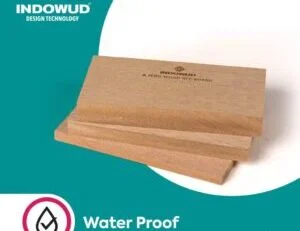
Rice husk panels, manufactured as NFC (Natural Fibre Composite) products like the Indowud NFC range, are engineered as termite proof boards, waterproof boards, and fire retardant boards, while also offering smoke-suppressant properties, excellent screw-holding strength, and easy machinability for furniture boards, doors, frames, decking, jaali work, fencing, façades, and partition boards.
Indowud NFC has earned CII’s GreenPro Ecolabel certification and an Environmental Product Declaration (EPD), giving independent validation to its sustainability credentials.
Why Rice Husk?
It is also abundant and renewable every year. Unlike wood, rice husk doesn’t naturally attract termites and insects.
For applications such as decking and fencing, rice husk boards perform well against rain, humidity, and changing temperatures. Indoors, they are equally suitable for partition boards, wardrobes, wall cladding, and interior panels. This allows architects to specify one material across multiple applications.
Why Europe Is Ready for Rice Husk Boards — And Why Indowud NFC Fits Right In
There’s a subtle change happening in the European furniture and interiors market. It’s not loud or trendy. It’s the kind of change that occurs when regulation, consumer awareness, and material science all begin aligning.
Buyers in Berlin, architects in Amsterdam, and procurement teams in London are increasingly asking the same question: where exactly does this material come from, and what happens to it at the end of its life?
Rice husk boards are becoming one of the strongest answers to that question. Indowud NFC, manufactured in India using rice husk, fits those expectations remarkably well.
The EU’s Ecodesign for Sustainable Products Regulation (ESPR), alongside the UK’s embodied carbon initiatives and increasingly strict indoor air quality standards, has made formaldehyde-free, low-VOC materials an important consideration rather than simply an optional feature.
Indowud NFC boards contain no wood fibre, resulting in low VOC emissions while maintaining durability suitable for schools, hospitals, offices, and residential developments.
The carbon story is equally compelling.
Rice husk is agricultural waste. Instead of being burned in fields, it is transformed into durable rice husk panels, reducing pollution while lowering demand for virgin timber. The finished husk panels are recyclable and contribute to more sustainable construction.
The performance side isn’t a compromise
This often surprises architects and designers discovering rice husk boards for the first time.
Many assume sustainable materials require performance compromises. Indowud NFC proves otherwise.
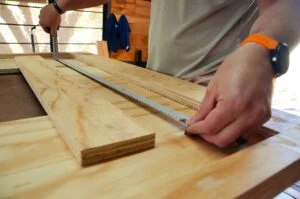
These husk boards machine, rout, cut, and fasten like conventional plywood while accepting laminates, veneers, paints, and stains with ease.
They also function as waterproof boards, termite proof boards, and fire retardant boards, making them suitable for demanding interior and exterior applications.
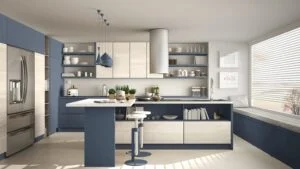
For kitchens, bathrooms, and other moisture-prone environments, these interior panels retain their structural integrity without swelling, warping, or delaminating—areas where conventional boards often fail.
Where this is heading
The building materials industry is under increasing pressure to reduce its dependence on timber.
Rice husk panels address two major challenges simultaneously: agricultural waste and deforestation.
They perform like conventional wood while offering the durability expected from modern interior panels, exterior panels, partition boards, and furniture boards.
That’s no longer just a sustainability story. It’s becoming a practical, economically sensible material choice—and Indowud NFC is one of the strongest examples of what that future looks like when supported by engineering, testing, and internationally recognised certifications.

Leave a Reply