
WPC Board vs Plywood: Which One Should You Actually Use for Furniture?
A WPC board resists water and termites without swelling or warping, which is one of the biggest issues people run into with conventional materials.
Plywood is made from thin layers of wood glued together and remains strong enough for many home applications. That works well until moisture finds its way inside over time. Some people choose one material over the other depending on the room, but it is not always obvious which one lasts longer once the weather changes. The plastic component in a WPC board helps improve moisture resistance and termite protection, although performance varies between products.
Best Use Cases for WPC Board
WPC boards work well in bathrooms and kitchens since they resist steam and water without warping easily. Outdoor furniture made from them performs well in places exposed to both heat and rain. They are also commonly used in commercial spaces because they require relatively little maintenance.
Kids’ furniture made from this material can also be practical because of its smooth finish. However, conventional WPC is not entirely free from concerns related to long-term durability, moisture ageing, or termite issues depending on the composition.
Plywood, on the other hand, provides a traditional wood appearance and accepts polish and veneers well. It is commonly used for wardrobes, office desks, decorative panels, and general furniture. However, being wood-based, it is still susceptible to moisture damage and termite infestation over time.
Many people now consider WPC ply board solutions for kitchens and bathrooms because moisture, termites, and rot become much less of a concern. While plywood often costs less initially, it may require repairs or replacement after five to seven years in humid climates.
Plywood is strong on paper, but anyone who has lived through a monsoon knows what happens when moisture gets between those glued layers — swelling, warping, and cabinet doors that suddenly stop closing properly.
WPC boards solve much of the moisture problem by combining wood fibres with recycled plastic, offering better resistance to humidity. However, that plastic content comes with trade-offs. It may not always provide the premium finish or sustainability many projects now demand.
This is where Indowud NFC changes the conversation.
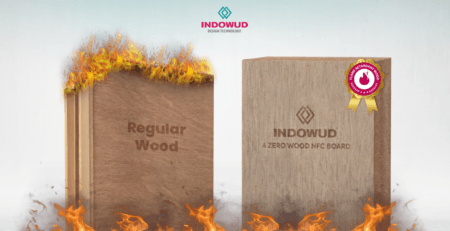
Made from rice husk, an agricultural by-product that would otherwise be burned, Indowud combines the natural silica found in the husk with engineered manufacturing to create durable rice husk boards that are waterproof throughout the board—not just on the surface. Unlike plywood, there are no wood veneer layers that can delaminate over time.
There is also the sustainability aspect.
While WPC boards reduce timber usage, they still rely on plastic. Indowud transforms agricultural waste into durable rice husk panels, earning certifications such as EPD, GreenPro, and RoHS without relying on plastic content.
If you are comparing plywood, WPC boards, and Indowud for humid-climate projects, Indowud addresses many of the challenges both materials are trying to solve while avoiding several of their limitations.
Final Verdict: WPC Board or Plywood?
When it comes to furniture and interiors exposed to moisture and changing weather, Indowud NFC offers a strong long-term solution.
It functions as a waterproof board and termite proof board, making it suitable for environments exposed to humidity, water, and heavy daily use.
Plywood may still be appropriate for dry interior spaces or projects where initial cost is the primary consideration, but it generally requires more maintenance and eventual replacement.
What makes Indowud NFC stand out is that it addresses many of the traditional weaknesses of wood-based materials. It does not swell, delaminate, or deteriorate because of moisture, giving homeowners and commercial projects greater peace of mind over time.
For hospitals, hotels, coastal properties, kitchens, bathrooms, and large commercial developments, long-term durability is not simply desirable—it is essential.
Indowud NFC is also a more sustainable option.
It is manufactured using rice husk, reducing dependence on timber while creating value from agricultural waste. It contains zero added formaldehyde and contributes to healthier indoor environments.
If you are looking for furniture and interiors that are durable, low-maintenance, environmentally responsible, and built for long-term performance, Indowud NFC represents more than an alternative to plywood—it represents a modern building material designed for the future.
FAQ: WPC Board vs Plywood
1. Is WPC board better than plywood for furniture?
Yes. A WPC board performs better in moisture-prone areas such as bathrooms and kitchens because it resists water and termite damage while requiring less maintenance than plywood.
2. Is WPC board more expensive than plywood?
Generally, yes.
A WPC board or WPC ply board usually costs slightly more than standard plywood, but the longer lifespan and reduced maintenance often make up for the higher initial investment.
3. Is plywood completely unsuitable for wet areas?
No.
Marine-grade plywood performs better in wet environments than standard plywood. However, ordinary plywood can still swell and warp when exposed to prolonged moisture.
4. Is WPC board eco-friendly?
Conventional WPC boards help reduce timber consumption by combining wood fibres with recycled plastic.
Products such as Indowud NFC go one step further by manufacturing rice husk boards from agricultural waste, reducing dependence on both timber and plastic while supporting more sustainable construction.



Leave a Reply