
Husk Panels vs Conventional Partition Boards: A Room-by-Room Comparison
Partition boards don’t get a lot of glamorous attention in a build. Nobody plans a home around their partition material the way they plan around flooring or lighting. But partitions do a lot of quiet work—they divide space, carry moisture load in wet areas, take knocks in high-traffic zones, and in commercial buildings, they’re often part of the fire compartmentalisation strategy whether anyone thinks about it that way or not.
Which is exactly why the choice between a conventional partition board—plywood, MDF, particleboard, gypsum—and rice husk panels like Indowud NFC deserves more thought than it usually gets. The differences don’t really show up on installation day. They show up two years later, in the room where they were used.
Here’s how that comparison actually plays out, room by room.
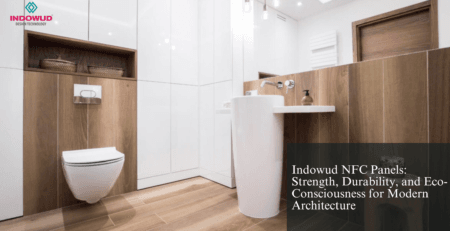
Bathrooms
Conventional boards, even “moisture-resistant” grades of MDF or plywood, are moisture-resistant at the surface, not through the full thickness. The moment there’s a cut edge, a drilled hole for plumbing, or a chip in the laminate, water gets a way in. In a bathroom, water is not an occasional visitor—it’s a daily, sustained condition.
Rice husk panels like Indowud NFC contain no wood fibre, so there’s no organic material for moisture to be absorbed into in the first place. That holds true at the surface, at cut edges, and around fixtures—which is precisely where conventional boards start to fail first, usually with swelling, delamination, or a musty smell that shows up long before visible damage does.
Winner for bathrooms: rice husk panels by a wide margin—this is the environment where the material’s waterproof board performance matters most.
Kitchens
Kitchens combine two stressors conventional boards handle poorly at once: moisture (spills, steam, dishwashing) and heat (stovetops, ovens).
MDF swells at the edges near sinks.
Particleboard cabinetry is a common failure point within a few years of daily kitchen use.
WPC handles moisture reasonably but can soften or deform near consistent heat sources.
Indowud NFC performs as a waterproof board through the full thickness of the panel and functions as a fire retardant board, carrying UL 94 V0 and ASTM E84 Class A certifications.
That matters more in a kitchen than almost anywhere else in a home, since kitchens remain one of the most common points of household fire origin.
Bedrooms and Living Rooms
These are lower-stress environments—no direct water exposure, moderate humidity, and mostly aesthetic and acoustic considerations.
Conventional boards perform adequately here, and it’s genuinely one of the few places where plywood or MDF partition boards can be a reasonable choice, particularly where budget is the primary constraint and the room has good climate control.
That said, rice husk panels still offer an advantage in humid climates or homes without reliable air conditioning, where ambient moisture over time can affect conventional wood-based boards.
Indoor air quality is another consideration, as rice husk boards release no formaldehyde or VOCs, while conventional boards may, depending on the adhesive system used during manufacturing.
Home Offices and Study Rooms
These rooms often contain electronics, books, and paper—all of which are more vulnerable to fire spread than many people realise.
Partition and shelving material selection matters more here than the room’s low-traffic reputation suggests.
Indowud NFC’s fire retardant board performance and absence of wood fibre—making it an inherent termite proof board—make it a stronger long-term option, particularly for built-in shelving and cabinetry that are expensive to replace.
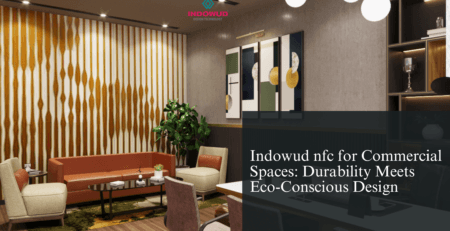
Commercial Interiors — Offices, Retail, Hospitality
This is where partition choice stops being a personal preference and starts becoming a compliance question.
Fire codes for commercial interiors continue to become more demanding, and partition boards are frequently part of a building’s fire compartmentalisation strategy.
A partition material that is combustible, produces heavy smoke, or degrades under repeated humidity cycling in high-traffic commercial settings becomes a long-term liability.
Indowud NFC provides fire retardant board performance with UL 94 V0 certification, dimensional stability under HVAC-driven temperature changes, and zero VOC off-gassing—features that are increasingly relevant for green building certifications and commercial procurement.
The Full Picture
| What Matters | Conventional Boards (Plywood / MDF / Particleboard) | Rice Husk NFC Boards (Indowud NFC) |
|---|---|---|
| Moisture | Vulnerable once water reaches exposed edges. Swelling, delamination and permanent damage are common if moisture gets in. | Performs as a waterproof board, remaining stable even in kitchens, bathrooms and humid climates. |
| Fire Safety | Fire performance varies and often depends on chemical treatments or coatings. | Built-in fire retardant board performance independently tested to UL 94 V0 and ASTM E84 Class A standards. |
| Termites & Pests | Can be attacked by termites if treatments wear off or become compromised. | Functions as a termite proof board because it contains no wood fibres. |
| Indoor Air Quality | Many products rely on formaldehyde-based adhesives that may release VOCs over time. | Manufactured without added formaldehyde and supports healthier indoor environments. |
| Dimensional Stability | Can expand, shrink or warp with changes in moisture and temperature. | Maintains dimensional stability with minimal movement over time. |
| Maintenance | May require repairs, replacement, termite treatment or resealing during its service life. | Designed for low maintenance with reduced need for repairs or protective treatments. |
| Where It Performs Best | Dry interiors with limited exposure to moisture, pests or demanding fire regulations. | Suitable for residential, commercial and institutional projects requiring durable interior panels and exterior panels. |
| Sustainability | Primarily manufactured from timber and wood-based raw materials. | Made from rice husk, reducing dependence on timber while utilising agricultural residue. |
FAQ
Can Husk Panels Be Finished to Look Like Wood or Laminate Partitions?
Yes.
Indowud NFC accepts veneers, laminates, paints, textured finishes, and can also be thermoformed for custom profiles.
The aesthetic flexibility of conventional partition boards is maintained.
Do Husk Panels Work for Load-Bearing Partition Applications?
Rice husk panels are primarily specified for non-load-bearing partitions, cladding, and panelling applications.
For structural requirements, consult Indowud NFC regarding the appropriate product specification.
Is There a Minimum Order for Commercial Partition Projects?
For project-scale supply, contact Indowud NFC directly to discuss quantities, timelines, and finish options.
Partition boards rarely receive much attention during specification, and that’s usually fine—until moisture, fire risk, or termites turn a low-attention decision into an expensive one.
Room by room, the case for rice husk panels holds up in nearly every environment where conventional boards eventually begin to show their age.



Leave a Reply