
Fire Resistant Boards for Home and Office: A Complete Buyer’s Guide for 2026
Fire safety used to be an architect’s concern, not something homeowners thought much about. That’s no longer true. Building codes have tightened almost everywhere, insurers are asking tougher questions before writing a policy, and after a string of high-profile building fires—from Mumbai to Manila to London—the people specifying interiors, whether for a house, a co-working space, or a hospital corridor, are now asking a question they used to skip entirely:
What actually happens to this material if a fire breaks out?
Fire Resistance
Fire resistance isn’t a single property. It includes several important performance characteristics:
- Flame spread—how quickly fire travels across the surface of the material.
- Smoke production—how much smoke it generates while burning, which is often what actually causes fatalities in a fire.
- Smoke toxicity—whether what’s released is just smoke, or harmful gases that make a fire significantly more dangerous.
- Self-extinguishing behaviour—whether the material continues burning once the ignition source is removed, or stops on its own.
A board can perform well in one area and poorly in another, which is exactly why reading a single “fire rated” claim on a product page tells you very little.
You need the actual test standard and the actual result when choosing a fire retardant board.
The Common Materials, and Where They Actually Stand on Fire
Plywood and MDF
Wood-based boards burn.
Some are treated with fire-retardant chemicals that slow flame spread, but the underlying material is still combustible, and once ignited, wood-based boards remain a significant smoke source.
Fire-retardant treatments are generally surface or impregnation processes, meaning performance can vary depending on application quality and may change over the life of the board.
WPC (Wood-Plastic Composite)
Fire ratings on WPC products vary enormously between manufacturers because the composition itself varies enormously.
There is no single WPC fire performance—only the performance achieved by a specific manufacturer’s formulation.
Rice Husk Boards (Indowud NFC)
This is where the fire conversation changes.
Indowud NFC contains rice husk with no wood fibre and no plastic—the two materials most commonly associated with flame spread, melting, and toxic smoke in conventional boards.
It carries UL 94 V0 certification, one of the industry’s most stringent flammability standards, together with ASTM E84 Class A certification and a Flame Spread Index of 6.
It functions as a fire retardant board, with smoke-suppressant properties that come from the material composition rather than a surface treatment that may wear away over time.
For architects and designers specifying interior panels where fire performance is a genuine requirement—not simply a compliance checkbox—that represents a different material approach from conventional wood-based boards.
Frequently Asked Questions
Can Rice Husk Board Be Used Instead of Plywood for Furniture and Cabinetry?
Yes.
For standard furniture and interior applications, Indowud NFC offers good screw-holding strength, machines cleanly, and accepts laminates, veneers, paints, and CNC detailing without requiring special tooling.
For structural spanning applications carrying heavy loads, structural engineers should specify the appropriate material.
However, for furniture, cabinetry, partition boards, and interior panels, it performs comparably to plywood while providing additional benefits such as moisture resistance and fire performance.
Does It Work for Exterior Applications?
Yes.
The combination of waterproof board, UV stability, termite resistance, and fire retardant board performance makes it suitable for exterior panels, façade cladding, fencing, decking, and exterior trims.
Its dimensional stability during temperature changes is also greater than many plastic-containing alternatives.
Is It More Expensive Than Plywood or WPC?
On paper, yes.
A sheet costs slightly more than standard commercial plywood.
But that is rarely how architects, builders, or developers evaluate materials.
The more important question is how the board performs after five or ten years.
Has it swollen because moisture entered the material?
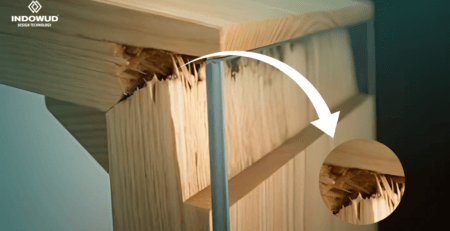
Has it required replacement because of termite damage?
Has it increased maintenance costs?
Those are costs that rarely appear in a BOQ.
When long-term maintenance, replacement, and operational downtime are considered, the difference in initial purchase cost becomes much less significant.
Is It Available Internationally?
Yes.
Although manufactured in India, Indowud NFC is already specified for projects across Europe, the Middle East, and Southeast Asia.
Many international projects engage directly with the company during the specification stage, particularly where fire safety and sustainability certifications are project requirements.
What Certifications Does Indowud NFC Have?
The construction industry depends on documentation.
Manufacturers can make many performance claims.
The important question is whether those claims have been independently verified.
Indowud NFC has been tested and certified against internationally recognised standards.
A Material Hiding in Plain Sight
The construction industry rarely changes because of novelty.
It changes when an existing material begins creating more problems than it solves.
If moisture caused swelling, that was expected.
If termites appeared after a few years, maintenance followed.
Fire ratings required additional treatments.
These were simply accepted as part of the job.
Then something interesting happened.
People stopped asking how to improve plywood and started asking a different question altogether.
Why are we still cutting down trees for applications where another material could perform better?
Rice husk wasn’t a new discovery.
Turning agricultural residue into durable rice husk boards capable of resisting moisture, termites, and demanding fire standards required rethinking what a building material could be made from.
That’s what makes rice husk boards like Indowud NFC different.



Leave a Reply