
Why Rice Husk Is the Most Sustainable Building Material You’ve Never Heard Of
Rice husk is something farms produce a lot of—hundreds of millions of tons of it every year across Asia, Africa, and Latin America. For a long time, it was treated as a problem rather than a resource. Farmers burned it in fields, dumped it in landfills, or just let it pile up on the roadside. In parts of India, the smoke from burning rice husk is part of the seasonal air quality crisis that hits every October and November.
That’s starting to change.
And the story of how rice husk became one of the most technically impressive building materials available today is worth understanding—whether you’re an architect specifying a commercial interior in Dubai, a homeowner renovating a flat in London, or a developer fitting out affordable housing in Chennai.
The Problem with What We Currently Build With
Before getting into rice husk, it’s worth understanding what it’s replacing—and why that replacement matters.
The global construction and furniture industry runs, overwhelmingly, on plywood, MDF, and increasingly WPC (Wood-Plastic Composite).
These materials are familiar, widely available, and functional up to a point.
But look closely, and the cracks show:
- Plywood consumes a huge amount of wood, putting pressure on forests.
- The adhesives used in plywood and MDF are typically formaldehyde-based.
- Those adhesives can keep releasing fumes into the air for months, sometimes years, after installation.
If you’ve ever walked into a newly furnished apartment and caught a sharp smell that gives you a headache, that’s likely formaldehyde.
In bedrooms and other poorly ventilated spaces, it’s a genuine concern.
Then there’s the performance problem.
Plywood swells when it gets wet.
MDF disintegrates.
Standard treated boards lose their termite resistance the moment a cut edge or drilled hole exposes the untreated material underneath.
And none of these materials offer meaningful fire retardant board performance—they burn, and once they start, they keep going.
WPC was supposed to fix some of this, and to its credit, it does.
It handles moisture better than raw timber and skips the need for painting.
But it still contains wood fibre, which means termites still have something to target if they find a way through the surface.
The honest take is that the materials most of us build and furnish our homes with are compromises we’ve accepted because we didn’t have a better option.
Rice husk boards are that better option.
What Rice Husk Actually Is — and What It Isn’t
Companies like Indowud NFC, based in Chennai, India, have spent over a decade refining the process of turning this agricultural by-product into high-performance rice husk boards.
The result is a Natural Fibre Composite panel with no wood fibre in its composition—just processed rice husk, bonded under high heat and pressure into a dense, stable composite that performs where conventional boards consistently struggle.
What a Rice Husk Board Actually Does in the Real World
Here’s where it gets specific—and the specifics matter.
Indowud NFC functions as a waterproof board.
It doesn’t absorb water—not at the surface, not at a cut edge, and not around a drilled fixing point after years of exposure.
For kitchens, bathrooms, wet areas, exterior panels, and coastal applications, that’s the difference between a board that performs for decades and one that begins failing at the edges within a few years.
It doesn’t attract termites.
That sounds simple, but it’s significant.
Termites require organic wood matter, and Indowud NFC contains none anywhere in its composition—not on the surface, not in the core, and not at routed grooves or hinge cut-outs.
That makes it an inherent termite proof board, particularly valuable for fencing, decking, cabinetry, and other ground-level applications.
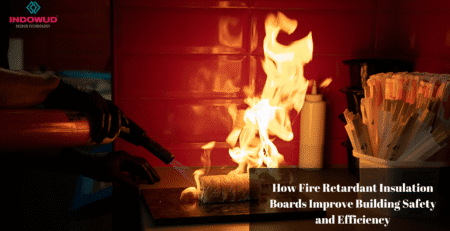
It also performs as a fire retardant board.
Indowud NFC carries UL 94 V0 certification, ASTM E84 Class A with a Flame Spread Index of 6, and IMO Class 1/A certification.
Its composition also produces significantly less smoke than conventional timber-based boards during fire exposure.
It doesn’t off-gas.
Indowud NFC contains no added formaldehyde and emits no VOCs.
That improves indoor air quality compared with many conventional wood-based boards, making it suitable for interior panels used in bedrooms, children’s rooms, schools, hospitals, and other enclosed environments.
The Sustainability Argument, Made Properly
Everything claims to be sustainable these days.
Most of it isn’t.
Rice husk boards are different because the sustainability starts with the material itself.
The raw material is agricultural residue that would otherwise be burned, contributing to seasonal air pollution across rice-growing regions.
Using rice husk as a manufacturing material doesn’t simply prevent waste.
It creates additional value within the agricultural supply chain by providing farmers with an income source from a by-product that previously had little commercial use.
There’s another benefit.
Every sheet of rice husk boards used in furniture, cabinetry, interior panels, or exterior panels reduces dependence on timber-based products.
At construction scale, that means lower demand for harvested wood.
The finished boards are also fully recyclable.
They carry GreenPro ecolabel certification from the Confederation of Indian Industry together with an Environmental Product Declaration—important documentation for projects pursuing green building certifications.
And then there’s durability—arguably one of the most overlooked aspects of sustainability.
A waterproof board that also functions as a termite proof board and fire retardant board is less likely to require repair or replacement over its service life.
Using materials that last longer reduces resource consumption, waste generation, and long-term maintenance, making durability an important part of sustainable construction.




Leave a Reply