
Rice Husk Boards vs Traditional Plywood: Which One Wins for Indian Homes?
It’s not hard to understand why plywood has been the default material for Indian furniture and interiors for decades. But familiarity isn’t the same as performance. And if you’ve ever dealt with a swollen kitchen cabinet after three monsoons, a wardrobe that smells musty no matter how many times you clean it, or the quiet horror of discovering termite damage behind a wall panel you fitted two years ago—you already know that plywood’s reputation is partly built on not having a better alternative to compare it against.
That alternative exists now. And it’s made from rice husk.
What Plywood Actually Is—and What It Hides
Plywood is made from layers of wood veneer that are glued together under pressure. The layers are arranged so that the grain of each layer runs perpendicular to the layer of wood veneer. This results in a panel that’s stronger than solid wood of the same thickness, and it is reasonably stable under normal conditions.
The problems with plywood are in the details.
The adhesives used to bond the layers of plywood are almost all based on formaldehyde. This includes urea-formaldehyde, melamine-formaldehyde, and phenol-formaldehyde. Different types of plywood use different formulations, but they all have one thing in common, which is formaldehyde.
Formaldehyde is a problem because it gets released into the air inside buildings for months or years after the plywood is installed. The E1 standard is the standard that many Indian plywood manufacturers say they follow. It limits formaldehyde emissions.
That might sound small. But in a closed bedroom or a compact apartment kitchen with limited ventilation—which describes a significant proportion of urban Indian homes—indoor air quality becomes an important consideration.
Then there’s moisture. Plywood’s wood layers absorb water. Not immediately, not dramatically, but consistently over time—especially at edges and cut surfaces where the veneer layers are exposed. Once moisture gets in, the layers begin to separate. The face delaminates. The board swells and warps.
In Indian kitchens and bathrooms, where humidity cycles dramatically between seasons, this process is not theoretical. It’s one of the reasons homeowners increasingly look for a waterproof board or a more reliable water resistant board for moisture-prone interiors.
And termites. Plywood is wood. Termites eat wood. Even treated plywood can become vulnerable once a cut or drilled surface exposes material underneath—which happens the moment a carpenter fits a hinge, routes an edge, or cuts a panel to size on site.
This is why choosing a reliable termite proof board has become increasingly important for Indian homes.
What Rice Husk Boards Actually Are
Rice husk is the shell of the rice grain that gets separated from the grain when it is milled. For a long time, rice husk was treated simply as agricultural waste. In India, large quantities of rice husk are produced every year, and improper disposal or burning can contribute to environmental problems.
Indowud NFC is a type of board made using this agricultural material. The rice husk is processed and formed into a strong panel under controlled manufacturing conditions.
The result is a new category of rice husk boards designed for furniture, interiors, and architectural applications.
These rice husk panels look and work much like conventional boards. They can be cut, drilled, routed, and laminated. But they behave very differently once installed and exposed to real Indian conditions.
Head to Head: Where the Difference Actually Shows Up
Moisture and Humidity
Plywood absorbs moisture. It’s wood—that’s what wood does. With proper sealing and treatment, you can slow that absorption. You cannot completely remove the underlying vulnerability of wood to moisture.
Indowud NFC is engineered as a waterproof board through the full thickness of the panel, rather than relying only on a surface seal.
For kitchens, bathrooms, and humid environments, this difference directly affects the long-term performance of interior panels and furniture boards.
Termite Resistance
Standard plywood: vulnerable, especially at cut edges and fixing points.
Marine-grade treated plywood: designed for improved durability, but site cutting and drilling can affect protected surfaces.
Indowud NFC: no wood fibre in the composition, which means the material is designed as a termite proof board throughout the panel—not just at the surface.
The termite resistance is inherent to the material rather than applied only as a surface treatment.
Formaldehyde and Indoor Air Quality
Standard plywood can use formaldehyde-based adhesives, depending on the product and manufacturing process.
Indowud NFC is designed with zero formaldehyde emissions. For interior panels used in bedrooms, kitchens, offices, schools, and healthcare spaces, indoor air quality is an important material-selection factor.
Fire Performance
Standard plywood can burn and contribute to smoke during a fire.
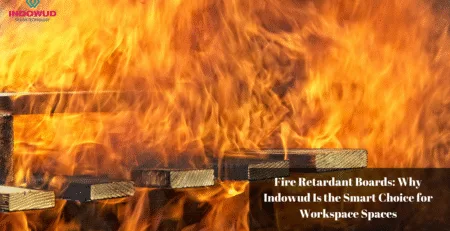
Indowud NFC is engineered as a fire retardant board with fire and smoke performance characteristics. Its tested fire performance includes UL 94 V0 and ASTM E84 Class A classifications.
These are not simply decorative surface properties. Fire performance is an important consideration when selecting partition boards, wall panels, furniture boards, and other interior materials.
Workability
This one is close to equal.
Indowud NFC machines with standard carpentry tools—the same saws, routers, drill bits, and finishing equipment a carpenter uses with plywood.
No specialised equipment or major change to the installation process is required.
For furniture makers, architects, and contractors looking for durable furniture boards or partition boards, this makes the transition from conventional materials easier.
The Price Question
Per sheet, Indowud NFC boards may carry a premium over standard commercial plywood. Against marine-grade or BWP-rated plywood, the gap can narrow depending on the grade, thickness, and project requirements.
But per-sheet price is the wrong number to anchor on when choosing between these materials for a home renovation.
The right calculation is: what does this decision cost me over ten years?
A kitchen fitted with Indowud NFC and properly installed is designed to reduce problems associated with moisture and termite damage. This can lower maintenance and replacement requirements over time.
When comparing the initial cost of materials, homeowners often look only at the waterproof board price or the cost per sheet. Long-term durability, maintenance, and replacement costs also need to be considered.
No special equipment or training is required. It cuts, drills, routes, and laminates much like plywood.
The Verdict
Traditional plywood wins on familiarity and initial price per sheet.
But when Indian homes need stronger moisture resistance, termite protection, fire performance, and better indoor material choices, rice husk boards like Indowud NFC present a strong alternative.
As rice husk panels, they can be used across furniture and interior applications while addressing several of the common problems associated with traditional wood-based boards.
Plywood, at its best, manages these challenges.
Rice husk boards like Indowud NFC are engineered to address them at the material level.

Leave a Reply