
Everything You Need to Know About Rice Husk Boards Before Buying
Buying a board material based on a salesperson’s pitch is how a lot of people end up disappointed two years into a renovation. So, rice husk boards deserve complete, research-backed awareness for durability, sustainability, and overall health.
Here’s the honest rundown.
What a Rice Husk Board Actually Is
Rice husk boards are made by processing rice husk—the outer covering removed from rice grains during milling—into a dense, bonded composite panel. It’s not wood, and it’s not wood-fibre board either, even though it can look and machine similarly to both. The distinction matters: wood fibre boards still contain wood particles, which means they retain some of wood’s vulnerabilities. A genuine NFC board made purely from agricultural rice husk doesn’t.
These engineered rice husk panels are increasingly being specified for both interior panels and exterior panels because of their durability and sustainability.
What to Actually Check Before Buying
Is it genuinely wood-free, or just wood-reduced?
Some products marketed loosely as “eco boards” still blend in wood fibre to cut costs, which dilutes the termite proof board performance and pest resistance you’re paying for. Ask directly, and ask for documentation.
Is the termite and water resistance built-in or surface-applied?
Surface treatments wear off or get bypassed the moment the board is cut, drilled, or routed. A board where the resistance is intrinsic to the material—true of properly made rice husk boards—holds up at every edge and cut, not just on the original factory surface.
What does the certification actually say?
“Eco-friendly” is not a regulated term, and anyone can print it on packaging. Look for actual third-party certifications—GreenPro, Environmental Product Declarations (EPD), and recognised fire test reports—rather than taking claims at face value.
Does it off-gas anything?
A significant portion of conventional board materials used in Portuguese and Spanish furniture manufacturing still rely on formaldehyde-based adhesives during production.
The problem is what happens after the furniture is installed: those adhesives slowly release formaldehyde into indoor air over months and years. Not dramatically. Not in a way you’d notice immediately. But in a bedroom in Lisbon, a nursery in Seville, or a small apartment in Porto where the windows stay closed through winter—it adds up.
Portugal and Spain both have warm, dry climates for much of the year. Outdoors, that helps. Indoors, homes are often sealed against heat or cold, and ventilation is frequently limited in older housing stock.
Indowud NFC boards are manufactured from rice husk without formaldehyde-based adhesives. The board contains no wood fibre, helping create healthier indoor environments for applications such as furniture boards, wardrobes, kitchens, and cabinetry.
How Does It Actually Perform Under Fire?
Most people never ask this question until something goes wrong.
Many regions have experienced increasingly severe wildfire events over the past decade, making fire performance an important consideration when selecting building materials.
The distinction between a board that simply chars and one that is engineered as a fire retardant board with smoke suppression becomes significant during an emergency.
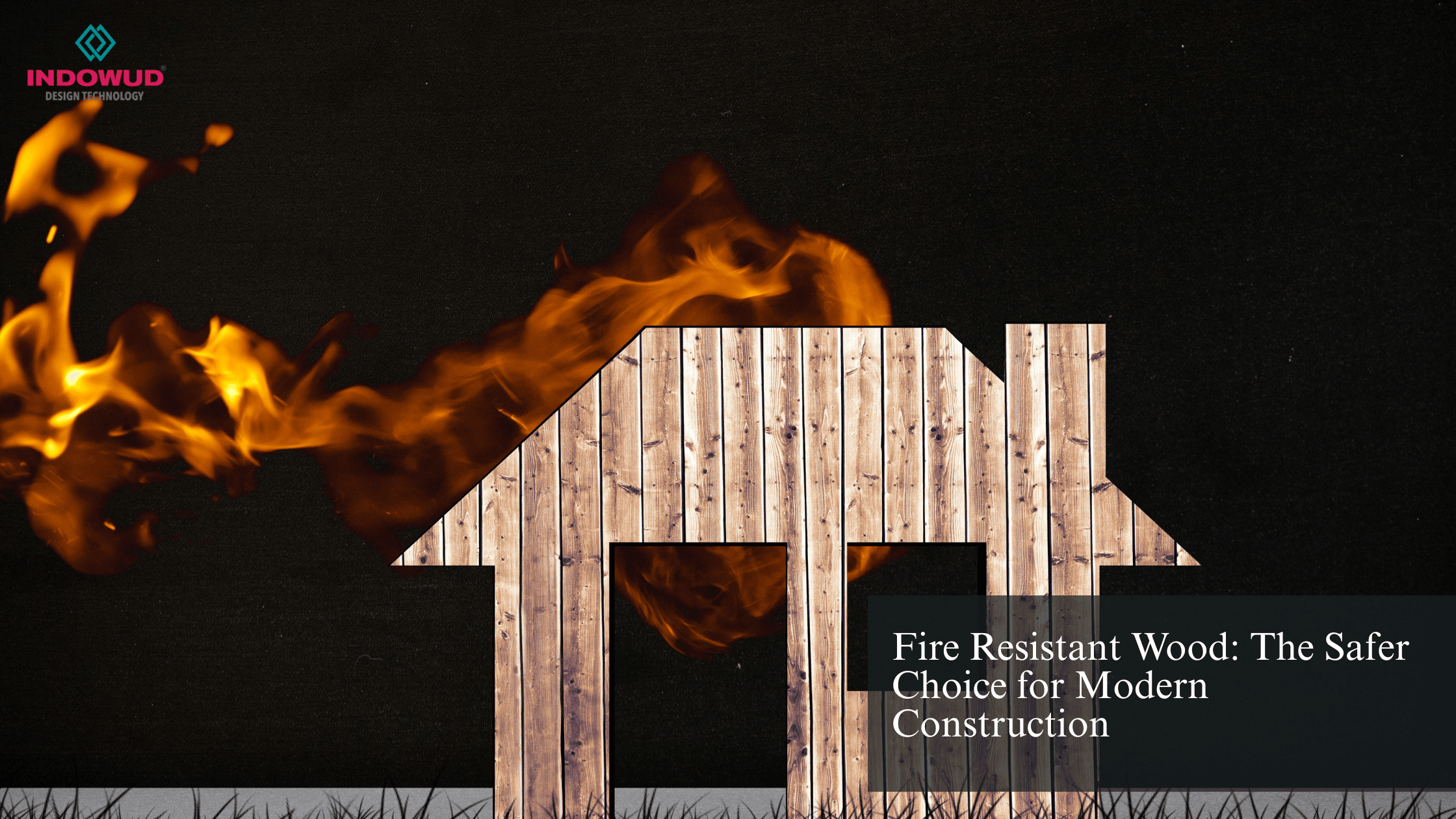
Indowud NFC boards carry a UL 94 V0 rating, meaning they self-extinguish within seconds after the flame source is removed. They also generate significantly less smoke than conventional treated plywood.
What Good Rice Husk Boards Should Actually Deliver
If you’re specifying or buying rice husk boards—whether you’re a furniture manufacturer, architect, developer, or homeowner—this is the baseline a properly engineered board should meet.
- Termite proof board performance and waterproof board protection built into the material itself rather than applied as a surface coating.
- Certified fire retardant board and smoke-suppressant performance.
- Strong screw-holding strength throughout the panel for cabinetry and furniture boards.
- A surface that accepts paint, laminate, veneer, and CNC machining just like timber.
- Genuine formaldehyde-free construction for healthier indoor spaces.
- Suitable for applications including interior panels, exterior panels, partition boards, cabinetry, wardrobes, and wall panelling.
A Quick Gut Check Before You Sign the Order
Buy based on documentation, not marketing adjectives.
A genuine rice husk board should be able to prove its waterproof board, termite proof board, and fire retardant board performance through recognised certifications.
Brands such as Indowud NFC provide documented test reports and certifications, giving architects, builders, and homeowners greater confidence before specifying rice husk panels for residential or commercial projects.
Leave a Reply