
Why Interior Designers Are Switching to NFC Boards for Modern Interiors
Interior designers are not known for switching materials without a reason. When experienced designers start quietly swapping out their go-to board material for something made from rice husk, it’s worth paying attention. Not because it’s a trend. Because trends in interior design tend to be not just about aesthetics, but also about performance, liability, and a growing realisation that the material specification decisions designers make have consequences that extend well beyond the handover date.
Here’s what’s actually driving the switch.
The Liability Problem Nobody Talks About Openly
When a kitchen renovation fails two years after completion—swollen cabinet bases, delaminating panels, a termite trail running up the back of a wardrobe—the client doesn’t call the carpenter. They call the designer.
This is the quiet reality of interior design practice that doesn’t come up in portfolio presentations or client pitches. Designers specify materials.
NFC boards—specifically rice husk panels like Indowud NFC—change this calculation. Waterproof through the full thickness of the panel, inherently termite-resistant, and dimensionally stable under humidity cycling, they offer designers an alternative to conventional interior panels where long-term material performance matters.
What Modern Interiors Are Actually Asking For
Not all clients—but a growing, vocal, and typically well-funded segment that reads about formaldehyde in plywood, researches VOC off-gassing in MDF, and wants documented answers rather than reassurances.
They require material-level documentation: Environmental Product Declarations, formaldehyde compliance certifications, and sustainability credentials that can be cited in a submission.
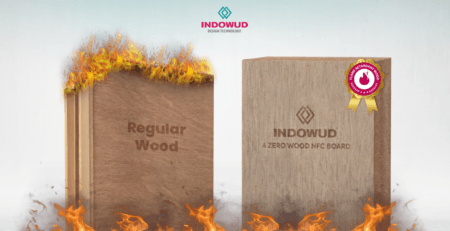
Indowud NFC, by contrast, is zero formaldehyde, GreenPro ecolabel certified, backed by an Environmental Product Declaration, and carries UL 94 V0 and ASTM E84 Class A fire ratings.
For a designer working on a green-rated project, these aren’t incidental features. The combination of sustainable rice husk boards and tested fire retardant board performance directly supports modern material specification requirements.
The Thermoforming Advantage Most Designers Don’t Know About
Here’s the feature that tends to get the most attention from designers once they start exploring what NFC boards can actually do.
Indowud NFC panels can be thermoformed—heated and shaped into curves, compound geometries, and custom forms that flat board materials simply cannot achieve.
Arched cabinet fronts. Curved partition boards and walls. Custom interior forms.
This is what genuinely excites designers who encounter Indowud NFC for the first time. It’s not just that it solves the problems of plywood. It’s that it enables design moves that plywood never could.
The switch to Indowud NFC can resolve multiple material challenges simultaneously. The zero formaldehyde certification supports green building submissions. Its waterproof board performance eliminates the need for additional sealing layers in bathroom vanities and bar counter surrounds.
And the material’s salt-air resistance—relevant for coastal applications—helps prevent the edge delamination commonly associated with wood-based panels exposed to prolonged humidity.
The Aesthetic Considerations
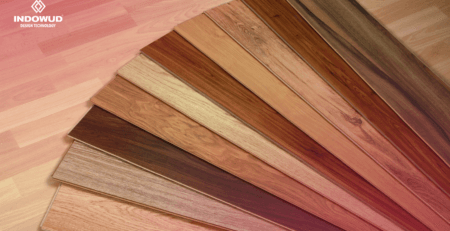
It accepts veneer application, paint, and textured finishes equally well.
CNC routing for decorative patterns—a technique that’s become increasingly standard in premium residential joinery—works cleanly and consistently, without the grain tearout or surface inconsistency that lower grades of plywood can produce.
For designers specifying furniture boards, wall panels, cabinetry, or decorative interior panels, this flexibility means material performance does not have to restrict the final design language.
Why the Switch Is Permanent for Most Designers
Designers who have specified Indowud NFC on one project and tracked the outcome tend not to go back to standard plywood for applications where the comparison is direct.
The reasons they give are consistent: fewer post-handover concerns about moisture damage, reduced termite-related problems, stronger fire performance for commercial projects, and better indoor air quality considerations for sensitive spaces.
As a termite proof board, waterproof board, and fire retardant board, the material addresses several performance requirements within a single panel.
The material simply performs without creating the downstream problems that standard plywood can develop during its service life.



Leave a Reply