
Fire Retardant Rice Husk Boards for Safer Interior Panels
Here I am, sitting at my kitchen table on a Tuesday afternoon, thinking about a fire retardant board.
A few years ago, if you had asked me about wall materials, I would have shrugged and said, “Maybe plywood? Whatever the contractor suggests.” That was the extent of my knowledge.
Then I started paying attention.
A warehouse fire near Chennai. A short circuit incident in a friend’s café. Nothing life-changing in my own life, thankfully — but enough to make me look at walls differently.
That’s when I began looking deeper into fire retardant boards. Not the glossy brochure version. The real version — the one that makes you ask, what exactly is inside this panel?
Why I Started Caring About What’s Behind the Wall
We obsess over paint shades. We debate matte versus gloss. We compare textures for hours.
But when it comes to what’s behind that finish? Silence.
The first time I heard about rice husk board technology, I assumed it was some temporary or rustic solution. It isn’t.
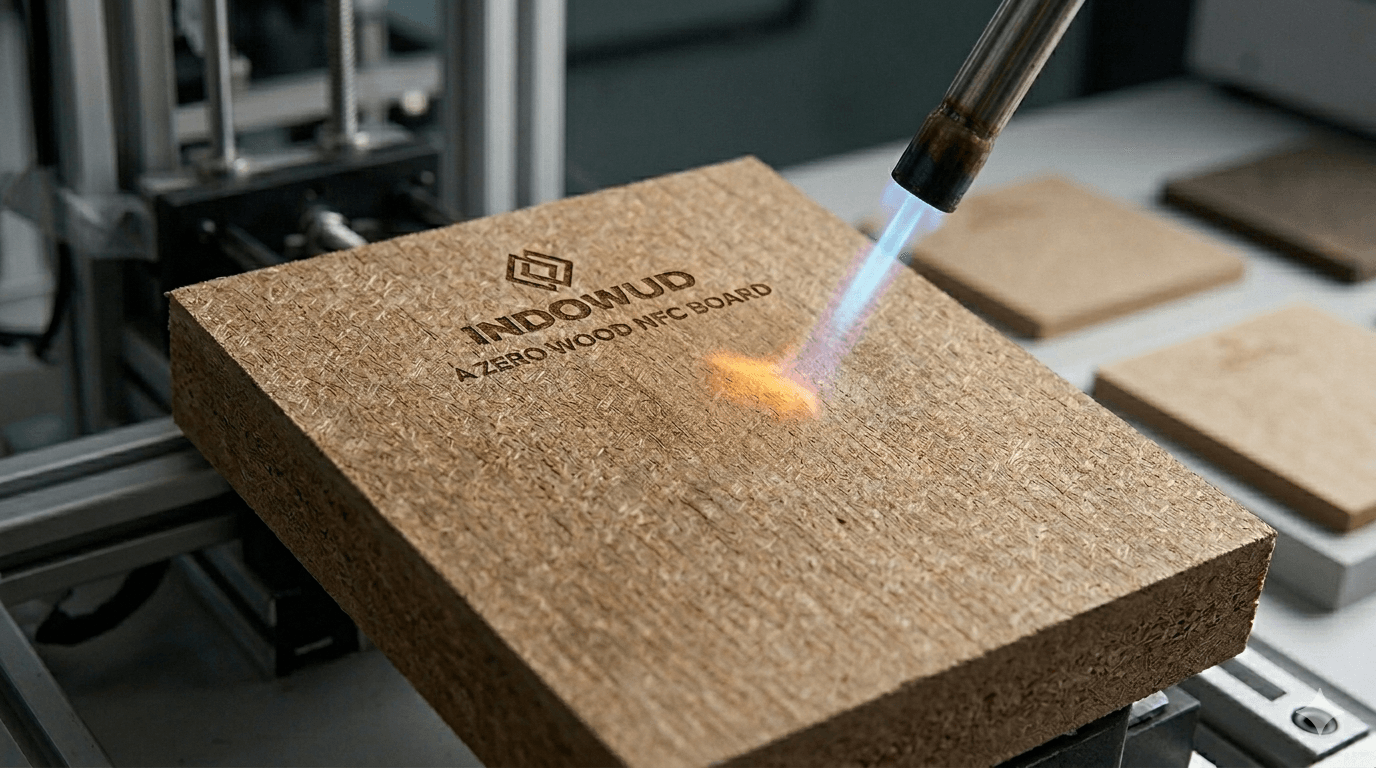
A properly engineered rice husk board is dense, stable, and designed to perform. When developed into a fire retardant board, it’s built to slow flame spread and, in some cases, self-extinguish once the ignition source is removed.
And in a real fire, time matters.
People often ask: Are rice husk boards fire retardant?
Some are. For example, boards like Indowud NFC are engineered and tested for fire performance.
But not every product marketed as “eco-friendly” is automatically safe. Sustainability and fire performance are not the same thing.
Strength Is Not the Same as Fire Performance
This was my biggest realization.
A board can feel strong and still perform poorly in a fire.
Fire performance depends on formulation, density, bonding systems, and certification testing. A rice husk board that has been properly engineered and tested under recognized standards behaves very differently from untreated panels.
That’s the line between marketing language and material science.
What Actually Matters When Choosing Interior Panels
Before specifying a panel system, these are the questions worth asking:
- Has it been tested for flame spread?
- What certification does it meet?
- Is it classified under recognized fire standards?
- Is it part of a tested wall assembly?
For example, a UL 94 V0 classification indicates self-extinguishing behavior under controlled testing. That means the material stops burning shortly after the flame source is removed.
A fire resistant board, on the other hand, is designed to withstand fire for a defined duration — 30 minutes, 60 minutes, or longer — depending on the full assembly.
When rice husk board technology is engineered correctly, it can function as a reliable fire retardant solution for interior panels in offices, hotels, and residential spaces.
That’s where the conversation becomes practical, not theoretical.
A Real Example
A friend of mine renovated a co-working space in Bangalore last year.
Budget constraints. Tight deadline. They initially selected a standard plywood-based panel system.
Then their consultant asked about fire ratings.
Everything changed.
They shifted to a fire retardant board system based on rice husk board technology. Not because it was trendy — because compliance required it. The alternative fire resistant options were heavier and significantly more expensive.
What surprised them most?
It didn’t look different.
It didn’t behave differently during installation.
Routing, cutting, finishing — all comparable to conventional boards.
That’s the misconception. We assume sustainable materials are complicated or fragile. Often, they’re not.
A well-designed fire retardant board performs like a standard panel in daily use — except it behaves very differently under heat.
And in commercial interiors, that difference matters.
The Simple Physics of It
Let’s strip away the jargon.
Imagine a standard untreated panel catching fire. Flame spreads quickly across its surface.
Now imagine a fire retardant board that slows that spread significantly.
Even a short delay can allow:
- Occupants to evacuate
- Sprinklers to activate
- Fire to remain contained longer
That’s not exaggeration. That’s material behavior under heat.
Some engineered boards char on the surface when exposed to fire, creating a temporary protective layer. That barrier reduces oxygen exposure and slows combustion.
The difference between “burns rapidly” and “buys time” may only be minutes.
But in fire safety, minutes are everything.
What I Know Now
Here’s what changed for me:
- A rice husk board can be engineered into a credible fire-performing material.
- Not all interior panels behave the same under fire conditions.
- A fire retardant board should not be treated as a luxury upgrade. It should be standard practice in many projects.
We’ll debate Italian marble versus local granite for hours.
But when it comes to whether a wall panel accelerates fire or slows it down? Silence.
Maybe because it’s invisible.
Maybe because it’s not glamorous.
But once you start paying attention to what’s inside the panel, it becomes impossible to ignore.
And honestly, that’s probably a good thing.




Leave a Reply