
Coastal & High-Humidity Board Specifications: Indowud NFC
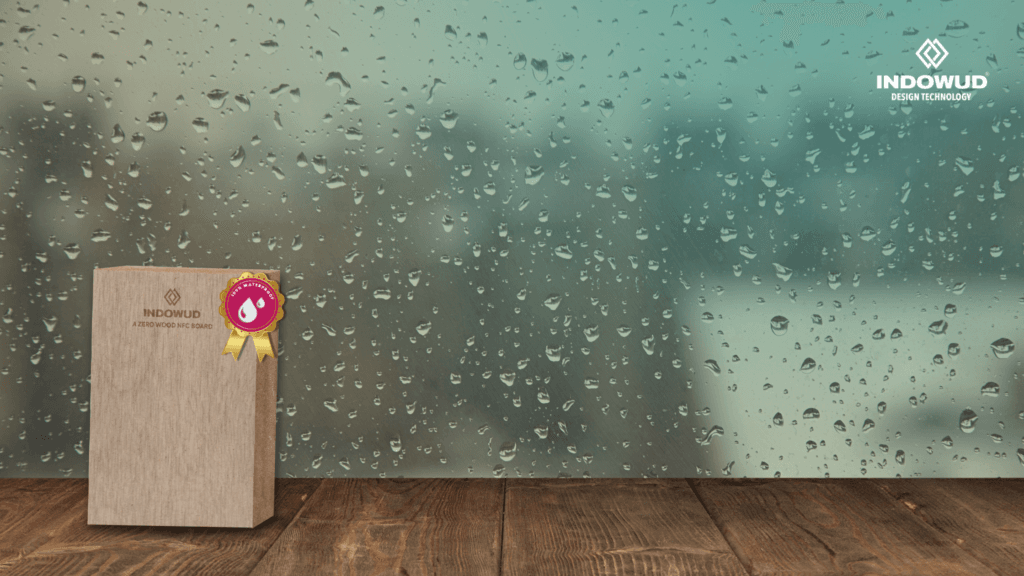
Why Coastal and High-Humidity Regions Need Different Board Specifications — and Where Indowud NFC Fits
Materials that hold up fine in drier places can fall apart after just a few years near the coast or in tropical spots. It’s not a manufacturing issue at all — the air itself and constant moisture create stresses that simply don’t show up inland. Salt in the breeze rusts metal hardware faster and starts breaking down edges on composites over time.
High humidity means boards rarely get to dry out between rains, so swelling and delamination become common after a while. Heavy seasonal downpours make it worse, because water sits on surfaces for days instead of drying quickly the way it might elsewhere. Termites add to the problem too, since they prefer the same warm, damp conditions found along coasts from South India to the southeastern US.
Fungal and algae growth is the other quiet culprit — driven by that same combination of sustained moisture and warmth, it affects any porous exterior surface that retains water rather than shedding it.
This is genuinely the brief we built Indowud NFC around.
Why “Standard” Board Specifications Fall Short
Most board material specifications — the moisture ratings, structural grades, and finish standards commonly referenced in the construction industry — were developed with a broad range of climates in mind, and many manufacturers’ default recommendations reflect moderate, temperate conditions rather than the sustained extremes of a tropical coastline.
A plywood grade that comfortably meets “exterior use” standards in a drier climate may need a meaningfully higher moisture-resistance specification to perform equivalently through a full monsoon season or a humid coastal year.
This is a common gap between architectural specification and on-the-ground performance: a board that passes standard testing can still underperform in the field simply because the standard testing didn’t simulate the specific combination of heat, humidity, and rainfall the material will actually face.
What to Specify Differently for Coastal and Humid Climates
Prioritise inherent water resistance over surface sealing. A board that resists water at the material level — rather than relying entirely on a paint or sealant layer to keep moisture out — has a meaningfully longer service life in sustained-humidity environments, because sealants and finishes degrade over time and coastal UV exposure accelerates that degradation. This is exactly the gap Indowud NFC was built to close: the resistance lives in the material itself, not in a coating that eventually wears thin.
Insist on termite resistance as a baseline, not an upgrade. In coastal and tropical regions, termite pressure is high enough that Termite Proof Board material should be treated as a standard specification requirement, not an optional premium feature. Indowud NFC contains no organic cellulose for termites to feed on, so this isn’t a treatment that needs renewing — it’s simply not there to attack in the first place.
Factor in expansion and contraction allowances. Any board material will expand and contract somewhat with humidity and temperature swings; the specification should include appropriate installation gaps — commonly around 10–12mm between board and wall, 4–5mm at ceiling and floor junctions, and 3–4mm between adjoining boards or deck panels — to accommodate this movement without buckling or cracking. We build these allowances into our own installation guidance for Indowud NFC rather than leaving it to guesswork on site.
Verify screw and fastener holding strength. Materials that soften or degrade with moisture exposure also tend to lose fastener grip over time — a particular concern for exterior cladding and decking, where fastener failure is a safety issue, not just a cosmetic one. Indowud NFC’s density and screw-holding performance is something we test and document specifically because of this.
Materials That Are Actually Engineered for This
Indowud NFC was, in a meaningful sense, developed to answer exactly this brief. For exterior applications specifically — siding, decking, façade panels, pool deck surrounds — the combination of water resistance, termite resistance, and weathering resistance matters more in coastal climates than almost anywhere else, because all three stresses are present simultaneously and year-round, rather than being occasional or seasonal concerns.
The Cost of Getting This Wrong Twice
One pattern that shows up repeatedly in coastal construction is what we think of as the “second renovation” problem: a building is specified with standard-grade materials, those materials underperform within a few years exactly as the underlying climate physics would predict, and the replacement project ends up costing more in total than if the correctly specified, higher-performance material had simply been used the first time.
This is a particularly common story with exterior cladding and decking in coastal projects, where the visible failure — peeling, warping, fastener pull-out — tends to show up within three to five years of using an under-specified material, well within the useful life a client reasonably expected from the original installation.
Architects and contractors working repeatedly in coastal markets increasingly build this lesson into their default specifications rather than relearning it project by project. Once a firm has managed one or two of these premature-failure replacement projects, the calculation shifts: the modest upfront premium for genuinely climate-appropriate material like Indowud NFC becomes an easy sell against the very real, very visible cost of a mid-life replacement.
Frequently Asked Questions
Does a board need a different spec for indoor use in a humid coastal city, or is that only a concern outdoors?
A bit of both, honestly. Indoor humidity in coastal cities tends to run higher year-round than in drier climates — even with the AC on — so kitchen cabinets, wardrobes, and bathroom vanities do better with moisture-resistant specs that might feel like overkill somewhere drier. It’s a big part of why we see Indowud NFC specified indoors in coastal cities just as often as outdoors.
Does UV exposure really affect the board itself, or is that mostly about the finish?
Mostly the finish — paint, laminate, and stain take the brunt of it, not the structural core of most engineered boards. That said, once UV wears a finish down, the material underneath is exposed to the weather directly, so it’s worth picking a base material that can still hold its own even after the finish has seen better days. This is one reason Indowud NFC’s water and weather resistance runs through the board itself rather than depending on the surface finish staying intact.
Is termite risk actually higher near the coast, or is that more of a general tropical-climate thing?
Mostly the latter — termites care more about humidity and temperature than salt air specifically. But coastal regions in the tropics often check both boxes at once, which is why the two get lumped together. Warmth and humidity, common to both tropical and many coastal regions, are the primary drivers of termite activity, which is why coastal tropical cities often see some of the highest termite pressure of any climate type globally.
Is Indowud NFC suitable for direct exterior exposure, including decking and siding?
Yes — this is one of Indowud NFC’s core design use cases. It’s engineered specifically to handle sustained water exposure, termite pressure, and weathering without the swelling or degradation typical of wood-based exterior products, which makes it a fit for siding, decking, façade cladding, and pool-adjacent applications in demanding coastal climates.





Leave a Reply