
Exterior Panels That Last: Why Rice Husk Panels and NFC Boards Beat Traditional Wood
Walk through any neighbourhood that’s a decade or two old and look closely at the exterior wood — fencing, decking, façade cladding, window frames. You’ll see the pattern everywhere: greying, cracking, sections swollen from old monsoons, the telltale pinholes of termite damage along the base. Wood looks beautiful on day one. The honest question is what it looks like on day three thousand, exposed to sun, rain, and pests with no break.
This is precisely where exterior panels expose the gap between traditional timber and engineered alternatives like rice husk panels.
Across the world, fire incidents in residential and commercial buildings are rising at a pace that’s hard to ignore — from apartment block fires in London and Dubai to wildfire-driven structure losses across Southern Europe, California, and Australia, the materials we build with are under more scrutiny than ever before. At the same time, termite infestations cause an estimated $40 billion in property damage globally every year, quietly hollowing out timber fences, decking, and façade cladding from the ground up — often invisibly, until the damage is already structural. These aren’t rare, dramatic events.
They’re the slow, expensive reality of building exteriors with materials that were never truly equipped for what the outdoors throws at them year after year.
Enter Indowud NFC
This is exactly where Indowud NFC changes the conversation.
Made from rice husk with zero wood fibre in its composition, there is simply nothing in the board for termites to target — not at the surface, not at a cut edge, not around a drilled fixing point. As a termite proof board, it offers protection built into the material itself.
With a UL 94 V0 fire rating that sees the board self-extinguish within seconds of a flame source being removed, it also performs as a certified fire retardant board, bringing a level of fire safety to exterior panels, fencing, and façade applications that treated timber cannot credibly claim.
In a world where both fire risk and pest damage are growing concerns, Indowud NFC isn’t just a better exterior material — it’s one designed specifically for these demanding conditions.
Why Exteriors Are Unforgiving
Interior panels get a relatively easy life — controlled temperatures, no direct rain, and limited UV exposure.
Exterior panels get none of that mercy.
They face constant sun exposure, heavy rainfall, humidity, temperature fluctuations, airborne pollutants, insects, and physical wear every single day.
Outdoors, timber faces a relentless set of pressures that compound over time. Constant sun exposure breaks down the surface grain through UV degradation. Temperature swings expand and contract the material repeatedly, quietly stressing every joint and fixing point until something gives.
At ground level, termites need nothing more than a crack or an exposed cut edge to get started.
The one thing holding everything together — paint, varnish, or sealant — begins deteriorating the moment it is applied. Miss a maintenance cycle, and timber quickly loses the protection that justified its cost in the first place.
Where Wood Actually Fails Outdoors
Every monsoon, every humid night, and every morning dew works its way into the grain.
The wood swells, dries, and shrinks hundreds of times over the life of a fence or deck, leaving joints looser, surfaces cracked, and panels increasingly vulnerable.
Algae and moss begin growing along damp surfaces. UV exposure turns timber grey. The base starts rotting where it contacts soil. Termites enter through untreated cuts and exposed edges.
Every few years timber demands sanding, sealing, repainting, or treatment.
The maintenance never truly stops.
How Rice Husk Boards Handle the Same Conditions Differently
Rice husk boards made from Natural Fibre Composite technology are fundamentally different because they are not wood.
They do not inherit timber’s natural vulnerability to moisture cycling or pest attacks.
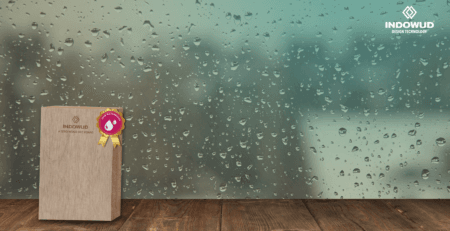
Indowud NFC rice husk panels are engineered as a waterproof board and termite proof board throughout the entire panel—not simply protected with a surface coating.
This matters enormously for exterior panels, where drilled holes, exposed edges, fasteners, and joints remain permanently exposed to weather.
For exterior applications such as decking, fencing, façade cladding, trims, screens, and even architectural partition boards, Indowud NFC offers several advantages that conventional timber struggles to match consistently.
- Built-in termite proof board and waterproof board performance.
- Certified fire retardant board and smoke-suppressant properties, increasingly important for modern façade systems.
- Anti-rodent resistance for ground-level installations.
- Thermoforming capability, allowing architects to create curves and custom shapes not easily achievable with timber.
The Long View
Traditional timber rarely fails overnight.
Instead, maintenance becomes part of ownership.
Rice husk boards like Indowud NFC are engineered to remove much of that recurring maintenance by combining durability, moisture resistance, fire performance, and pest resistance within the material itself.
If exterior panels are where timber quietly fails over time, they are also where rice husk panels make perhaps the strongest argument for becoming the future of sustainable exterior construction.



Leave a Reply